
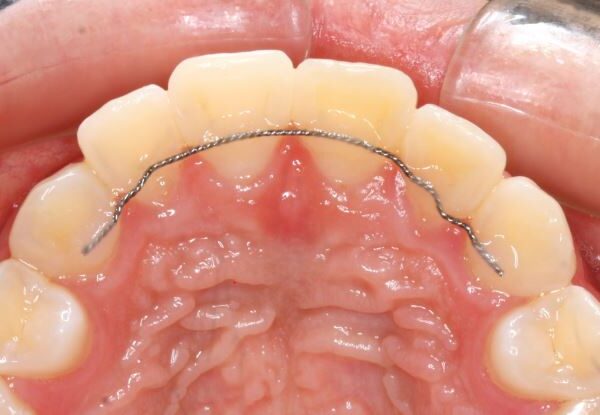
What should we do if a new patient shows up and wants to repair a fixed retainer or to make a new one?
Problems with fixed retainer repair
You may think, “It’s not a big deal. I can just apply flowable resin on the wire and that’s it”. But things can go wrong. Many of my general practitioner friends were unhappy with their fixed retainer patients. I found three problems with them.
1, They didn’t prepare for it to fail again soon.
2. Their fee was cheap.
3. They didn’t educate patients properly.
Let’s get deep into each of them..
1. Relapse can occur with fixed retainer
First, be aware that even if you place a perfect fixed retainer, teeth can still shift. Interproximal space can open up or teeth can shift. Why? Because fixed retainers are flexible and weak. And the contact area is small. They hold only a small portion of the tooth. But in the mouth, it is not a peaceful world. It’s a battlefield. Teeth are hammering each other. If your patients are bruxer, it’s way worse. Sometimes, crunch food can get stuck and push the wire. What if patients have fremitus? It tells us to “be cautious”. It also gives us excuses not to make fixed retainers. Because it will fail easily if the patient has fremitus. Make sure to check for a fremitus by placing your fingers on anterior teeth.
Another source of relapse is from the wire bending accuracy. If the wire wasn’t bent passive against teeth, teeth can shift. The retainer can become an active wire.
2. Repair price
Second, charge high enough for repair or remake. Charge for removal of remaining resin or wire as well. Have you removed them? It is quite annoying and takes a long time. If you use a low-speed handpiece, the vibration can be quite painful.
3. Importance of good communication
Thirdly, educate patients. Let them understand that fixed retainers can easily fall out, no matter how well they’re bonded. Educate them that they also have to wear removable retainers. Ask if he or she wears a removable retainer. If they don’t have removable retainers or their removable retainers don’t fit, make new ones. If they refuse, a fixed retainer shouldn’t be made.
If you just make a fixed retainer and the patient doesn’t have removable retainers, they may blame you if a tooth shift or a gap opens up. They may say.
“Why are my teeth crooked again? Was the retainer made incorrectly?”
If you stick to these three principles, you can avoid the stress from the fixed retainers.